Whether you’re a newly minted Ph.D. applying for your first-ever academic position or you’re looking for new opportunities after more than a decade in higher education, the faculty application process can be overwhelming. From the number of applications you submit to the amount of material included in each application packet, it’s easy to start working on autopilot and submit the same template for each job listing. 

But by using some best practices—and doing a little prep work beforehand—you can strengthen your faculty applications so that they’re self-assured, noteworthy, and well curated. Faculty job applications are your opportunity to make the case that not only will you be a valuable colleague, but you are also already putting your mark on the field. Follow these tips to make that case with confidence. 

​​​Prepare All Your Materials

The academic recruitment process often moves slowly, but you need to respond to job listings as quickly as possible. Save yourself some future stress and get organized on the front end: Keep different versions of your CV and cover letters in one place, make sure you have an up-to-date list of notable accomplishments that you can include in application packets, and have your requests for letters of recommendation ready to send.  

Faculty applications include a lot of moving pieces; using tools like Interfolio’s Dossier allows you to store and prepare all your materials in one place so that you’re ready to send polished, compelling, and comprehensive applications at a moment’s notice. 

​​Keep Your CV Focused and Short

It’s natural to want to include all of your credentials in your CV—and if you’re a young professional seeking a first-time position, you may not know which accomplishments should make the cut. While it’s wise to have a comprehensive CV on hand, you’ll want to send shorter, more focused versions in your applications that include only the accomplishments and experience most relevant to the position you’re seeking. 

Prioritize your highest-prestige accomplishments, then consider other credentials for their relevance to the position you’re applying for. For example, if you spent your first couple of years in graduate school writing book reviews and encyclopedia articles, you may not need to include that experience on your CV unless it clearly illustrates subject matter expertise or a skill you want to showcase for a specific job opportunity.  

Remember that academic CVs can easily be 10 pages or more: Save the hiring committee’s time, and show you understand the specific needs for an open position, by editing your CV down to the accomplishments you believe the hiring committee will care about most. 

Position Yourself as a Well-Rounded Colleague 

You’re more than the accomplishments on your CV. Institutions are looking to hire faculty with a certain type of experience, but they also want to recruit talent that will contribute holistically to the prestige and vitality of the department, school, or university.  

To put your best foot forward, look for opportunities to showcase the following: 

  • Teaching effectiveness and student engagement 
  • Collaborative experience within your department, college/school, and community 
  • Commitment to diversity, equity, and inclusion 
  • Professional development and continuous improvement

Packaging a well-rounded faculty job application will show hiring managers not only what you have already accomplished but also what you can contribute to their institution in the future. 

Give Your Cover Letter Some Life 

If this is your first time applying to a faculty position, you may feel overwhelmed by the sheer number of documents you need to write and assemble—and if you’re already a seasoned faculty member, you may simply be exhausted. But your cover letter is your opportunity to communicate what your CV and samples can’t. Are you passionate about your work? Are you enthusiastic about your line of research? Take some time to convey this in writing.  

The people reviewing your application will likely be disciplinary colleagues, so feel free to use some specialized language, but don’t hamper your cover letter with too much jargon. Instead, write as though you are talking directly to the hiring committee, telling them what it is about this position that excites you. And remember, for as many cover letters as you’ve written, the people on the other end have read even more. Keep it short, and they’ll thank you.  

​​​Think Strategically About Letters of Recommendation 

Letters of recommendation are critical, and it’s important that they come from the right people. Consider the context of the job you’re applying for when you decide whom to approach for a letter. Select someone who can speak to your skills or accomplishments in the specific area you’re pursuing, and whose opinion will carry weight with the hiring committee. 

Faculty who are more advanced in their career will be able to seek interdisciplinary recommendations from a wide range of colleagues, but if you are fresh from your studies, you’ll likely seek a letter from your adviser or a member of your dissertation committee. In all cases, be sure your recommender knows what to say. Ask them to include certain information, from details about your academic performance to a character reference, that will make your application shine. 

From asking for letters to collecting them and sending them on, it can be difficult to manage the letter of recommendation process in a short timeline. For a seamless recommendation process, use Interfolio’s online academic dossier service, which enables you to request, store, and send letters confidentially and with ease from one central location. 


Build Your Dossier With Interfolio.
Advance With Confidence.

Applying for academic programs or positions requires many artifacts. Put your best foot forward with Interfolio.

Start building your dossier for free today.

Higher education leaders have already been navigating much uncertainty this year. Looking ahead to fall 2025, it could be more severe as higher education institutions expect to face the full impact of the long-awaited “enrollment cliff,” an anticipated decrease in overall student enrollment caused by a smaller group of 18-year-olds in the general population. For smaller institutions, the effects of this cliff will be especially acute.  

Smaller institutions play an essential role in the country’s higher education landscape, but financial and societal pressures compound already stressful situations for their faculty members, leading to burnout and turnover. In light of these challenges, it’s even more important that smaller colleges and universities continue to support talented faculty—and there are ways to do it without straining increasingly limited resources. 

Why We Need Smaller Institutions 

Smaller institutions fill a fundamental role in their local economies and offer significant benefits to both students and faculty. Their smaller class sizes allow for more lesson plan personalization and one-on-one learning opportunities, and their faculty members may have more flexibility to try new approaches to teaching and research. When faculty are empowered to take chances, both students and the university stand to benefit from these learning opportunities, which may include new courses, projects, or research. 

Another benefit of this personalized approach is that faculty are able to make individual connections with students—and perhaps introduce more students to their particular field or discipline. Building these collaborative networks of students and faculty can lead to improved educational and research outcomes for both parties, as well as improve the standing of the institution overall. 

Current Challenges  

Given their size, smaller universities and colleges are less insulated from economic and societal challenges, especially when it comes to declining student enrollment and increasing faculty burnout. 

Enrollment Decline and Closures 

Colleges and universities of all sizes experienced a 15% decrease in enrollment between 2010 and 2021. In the first half of 2024, more than one college per week announced its closure, many of which were smaller institutions. 

Contributing to this decline are changing attitudes toward the value of a college education. The number of Americans who think it’s important to get a degree is declining, driven by concerns about the cost and an increase in professions that no longer require secondary degrees. 

Faculty Burnout 

Most faculty (67%) say they are experiencing increasing workloads, and nearly two-thirds (64%) of them report feeling burned out. Faculty at smaller institutions who may have to take on multiple roles potentially face even higher levels of stress. 

A large part of this burnout is related to time management. A whopping 83% of faculty say that they wish they had more time to spend on important matters—not administrative tasks. Not only are these faculty members overworked, they aren’t able to spend time on tasks they’re passionate about: their research, curriculum development, and student mentorship. 

Faculty Satisfaction 

Faculty satisfaction has decreased in three key areas between 2021 and 2023: promotions and tenure processes, anticipated career paths, and compensation. Faculty feel connected to their institution and supported by administrators, but they report a lack of appreciation and recognition for their efforts. And at least one in four faculty members believe their teaching and research efforts are undervalued. 

Importance of Faculty at Smaller Institutions 

Faculty members are an essential component of higher education institutions at all sizes. In addition to coursework, faculty influence nearly every organizational and administrative aspect of the institution, from governance and student success to revenue and rankings. Given the essential roles that faculty play, the costs of high faculty turnover are high. And at a smaller institution? The departure of a key faculty member can have an even greater impact. 

To prevent burnout and turnover, institutions must consider how to best support their faculty and provide resources to alleviate some of their main stressors. In particular, smaller institutions must support faculty career growth and identify tools to showcase their varied activities. 

Software to Support Faculty 

Universities stand to retain faculty for upward of 30 years if they’re tenured—but not if faculty don’t feel valued for their work. College administrators, at smaller institutions especially, have an important role to play when it comes to inspiring faculty confidence and encouraging retention. 

Administrative tasks are a necessary part of most roles, but when faculty members spend an outsized amount of time on admin, it substantially reduces their energy for meaningful work—namely, teaching, research, and service. And when institutions don’t make an effort to free up faculty time, faculty members can begin to feel like the institution doesn’t care.  

Smaller institutions feeling the strain of enrollment and faculty burnout can take three key steps to make sure their faculty members feel supported and valued: 

1. Reduce administrative tasks. 

Using Interfolio’s Faculty Information System (FIS), institutions can give faculty their time back (even just 10 hours over the course of a semester) to maximize their interactions with students. The FIS enables faculty to automatically pull in their publication data, populate web profiles, and use the same data for administrative requests, annual reviews, and promotions, freeing up time to focus on their highest-value activities. Additionally, it can support the data and reporting needs of hiring and review committees, streamlining these processes for all stakeholders. It also gives administrators better visibility into faculty accomplishments and workloads. 

2. Improve visibility into how faculty support the institution’s goals. 

As public perception of the value of a college education decreases, it’s more important than ever to show the impact of faculty work. With Interfolio’s FIS, institutions can centralize faculty data, allowing them to see research, courses, awards, service, and more all in one place—and more easily and effectively advocate on behalf of faculty. Plus, this same body of data can fuel public web profiles, showcasing faculty work more broadly and enabling cross-institutional and cross-disciplinary collaboration. 

3. Enable faculty to curate their story. 

Faculty want a way to showcase their work and accomplishments in a way that will help advance their careers. The Interfolio FIS is a widely adopted system that makes it easy for faculty to centrally document their activities across research, teaching, and learning. With this easy-to-use software, faculty can then focus on the substance of their annual review, tenure case, award application, and more. 

Higher education is often under pressure, but your faculty members don’t have to take the brunt of it. Learn how your institution can support your faculty members using the Interfolio Faculty Information System. Contact us to schedule a demo today. 

Submitting letters of recommendation is an important, but often complicated and challenging, part of the already stressful medical school application process. Alongside your transcripts, MCAT score, and personal statement, letters of recommendation help paint a complete picture of your academic and professional accomplishments. But asking for them can be time-consuming and awkward.  

We know better than anyone what goes into the arduous process of sourcing and submitting letters of recommendation. Read on for our advice on submitting an impactful letter, using Interfolio’s Dossier as a valuable component of the application process.

Who to Ask for a Medical School Letter of Recommendation

First, you’ll need to figure out exactly who should write your letters. This choice is an extremely important part of the medical school application process; the right recommendation letter might keep your application competitive with applicants who have similar credentials (high GPAs, MCAT scores, and thorough résumés of extracurricular and community-based activities). Think strategically about whom to ask for the most effective evaluation of your intellect, work ethic, and potential. 

The best individuals to contact for letters of recommendation are professors who know you personally because you have taken a class (or multiple classes) with them. While a department head or academic advisor you’ve met with several times may be able to speak to your character, a professor who has worked directly with you in a classroom setting will be able to comment more thoroughly on your academic abilities.

Other than professors, there are many individuals you may want to get in touch with for a high-quality recommendation letter. Seek out mentors, community leaders, doctors you’ve shadowed, research professionals with whom you’ve collaborated, or other healthcare professionals who can comment on your skill with patients. 

What matters most is that the person writing your letter of recommendation is someone who knows you in a professional or academic capacity and whose opinion will carry weight with medical school faculty. 

How Many Letters You’ll Need

The exact number of letters required depends on the MD program you’re applying to. Typically, med schools require two to five letters written on behalf of the applicant. However, they may welcome additional letters you want to include in your primary application. According to The Princeton Review, most med schools require three recommendations, while others accept six or seven. Be sure to note any specific requirements around who should author these letters and whether or not you may include additional letters.

How to Ask for a Recommendation Letter

You might know the proper protocol surrounding how to ask a trusted colleague, professor, or acquaintance for a recommendation. But if it’s been a while since you last requested a recommendation and you need a refresher, we’ve got the information you need. When you’re ready to send the request to your letter writer, these helpful steps will walk you through the process in Interfolio’s Dossier, which has been used by millions of scholars to pursue academic programs and positions.

Time Frame

When seeking recommendation letters, timing is crucial. You want to give your contacts enough time to create a well-crafted letter. It typically takes about 12 days from when a letter is requested to when it is uploaded into our Dossier system. This varies based on the letter writer; some might submit it the day after you request it, while others need several weeks’ notice, especially if they are providing letters for more than just one student.  

The absolute minimum amount of time you should give your med school recommenders is two weeks. With less notice, your contact may not have enough time to write a comprehensive letter that truly reflects your capabilities, or they may not be able to write you a letter at all if they have too many prior commitments. When you give too much notice, on the other hand, you run the risk of the contact forgetting to write the letter. If you decide to ask for a recommendation months in advance, you’ll want to follow up with your contact a few weeks ahead of the deadline to remind them when it’s due.

Components of the Medical School Letter of Recommendation

In your letter request, you should lay out exactly what medical school admissions committees are looking for in their applicants—this is especially helpful for recommenders who haven’t written a medical school letter of recommendation before. Providing this information will equip them to make a stronger argument on your behalf, thus improving the quality of your med school application.

There are several important points recommenders should touch upon in the letter. The Association of American Medical Colleges offers some guidelines for developing the perfect medical school letter of recommendation. Namely, the letter writer should:

  • Explain their relationship with the applicant, including how many years you’ve known them.
  • Focus on how the applicant’s behavior will contribute to their expected success in medicine.
  • Include any obstacles the applicant has overcome in relation to their professional development and education.
  • Describe how the applicant is competent in the following areas that are necessary for med school:
    • Critical thinking
    • Quantitative reasoning
    • Scientific inquiry
    • Written communication
    • Competencies in the sciences, such as life sciences and human behavior
    • Social skills
    • Teamwork
    • Oral communication
    • Ethical responsibility
    • Adaptability
    • Dependability

By providing the letter writer with a framework from which they can develop their recommendation, you’re ensuring they touch on the major points med school admissions officers want to see. Consider sending examples to give them an idea of what makes a strong med school recommendation letter.

Letter Length 

If your letter writer isn’t sure how much or how little to include in their recommendation, you can tell them that these letters tend to be about two pages. While the letter should be no less than a page and no more than three pages, anywhere in this range is acceptable. It’s important that the letter writer prioritizes quality over quantity. If a one-page letter has all the content needed for an excellent recommendation, there’s no need to pad the word count. 

How to Submit a Confidential Recommendation Letter

Often, those who write a letter on your behalf would prefer to have this information transmitted confidentially. If you need to submit a confidential letter and make sure it’s approved by the American Medical College Application Service (AMCAS), you can submit your letter via the AMCAS Letter Writing Service or Interfolio’s Dossier. 

Applicants who use Interfolio gain the following benefits: 

  • Quality checks of your letters of recommendation before delivery
  • Guaranteed letter content confidentiality for your letter writer and you
  • A customer service team ready to field all your questions
  • A central place to gather recommendation letters and other application materials before submission

No matter what avenue you choose to deliver your letters, keep this advice in mind during each step of the recommendation process: Ask the right people, give them enough time, make sure they’ve provided the right content, and deliver the letters on time and in full. 

Interfolio’s Dossier enables scholars to collect, curate, polish, and send out their materials at all stages throughout their journey. Learn more about Dossier here.


Tanya Johnson, PhD

Senior Administrator at Johns Hopkins University

Founder and Owner of Aspire Pinnacle

Antione D. Tomlin, PhD headshot

Antione D. Tomlin, PhD, PCC

Associate Professor of Academic Literacies, Communications, and English

Anne Arundel Community College

In higher education, students are more than learners—they are individuals navigating complex academic, social, and personal experiences. The Humanization Framework for Higher Education is a transformative model that centers care and empathy at the heart of institutional service practices. Recognizing that a student’s holistic experience directly impacts their academic success and personal growth, this framework calls for an intentional, inclusive service culture. It integrates nine key pillars: empathy, personalization, transparency, exclusivity, consistency, community, crisis management, student prioritization, and a collective service culture. Together, these elements drive a people-first (i.e., human-first) approach to student engagement, creating equitable and meaningful experiences while promoting operational excellence. We note that this approach can be very impactful for faculty and staff supporting students. 

Here are the reasons why the nine key pillars of the framework are essential for enhancing operational efficiencies at higher education institutions:

  1. Empathy ensures that service interactions are rooted in understanding and compassion.
  2. Personalization tailors support to individual student needs.
  3. Transparency promotes trust through clear and honest communication.
  4. Exclusivity ensures that services are designed with intentional inclusivity, recognizing diverse student experiences.
  5. Consistency upholds reliability and fairness in service delivery.
  6. Community fosters a sense of belonging through engagement and collaboration.
  7. Crisis management prepares institutions to respond effectively to student challenges with care and efficiency.
  8. Student prioritization centers decision-making around student well-being and success.
  9. Service culture integrates these elements into a cohesive, institutional commitment to human-centered, responsive, and transformative service experiences.

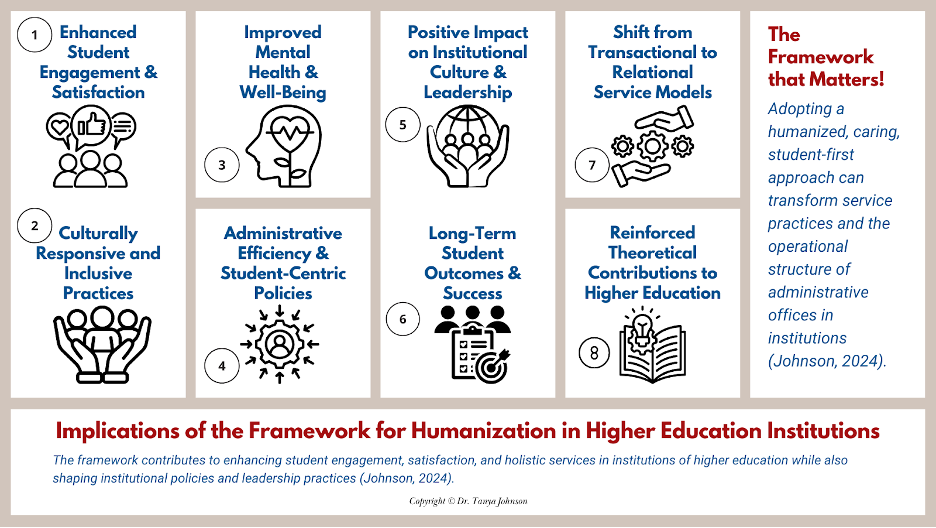
The purpose of this framework is simple but profound: to guide faculty, staff, and administrators in embedding humanistic principles into their daily interactions, policies, and operational decisions. By integrating components such as empathy, personalization, and transparency, the framework is designed to help higher education institutions bridge the gap between transactional service delivery and meaningful connections. 

At its core, this framework is more than a model—it is a call to action, a commitment to humanizing the way we serve, lead, and operate within institutions. By embedding empathy, inclusivity, and intentional service into our practices, we create an environment where individuals feel valued, heard, and supported, ultimately transforming operational efficiencies and enriching the human experience.

By emphasizing proactive support, clarity in communication, and a student-centric mindset, the framework ensures that institutions meet students’ academic and personal needs with understanding, reliability, and care. As higher education faces shifting demands and diverse student populations, institutions will not only retain students but help them thrive.

Ultimately, the Humanization Framework reflects a commitment to elevating higher education environments by emphasizing compassion, community, and holistic student engagement. It serves as a blueprint for faculty and staff to build deeper relationships with students, foster belonging, and provide support tailored to the diverse challenges that students face today. This work, driven by a passion for humanization and leadership, stands as a call to action for institutions to center care in their mission to educate and serve.

A Depiction of the Humanization Framework’s Implications

Examples of the Humanization Framework in Practice: 

1. Empathy: Understanding Unique Needs

  • Scenario: An international student struggles to adapt to both the academic rigor and cultural differences at their institution.
  • Application: Staff from the student success center take a compassionate, relational approach by regularly checking in, offering tailored academic support, and connecting the student with cultural affinity groups. Faculty demonstrate empathy by understanding language barriers and providing extra office hours.

2. Personalization: Tailoring Support to Individuals

  • Scenario: A student with a disability requires specific accommodations for exams and coursework.
  • Application: Advisors collaborate with faculty to design a support plan that suits the student’s needs, including alternative testing options and accessible learning resources. By tailoring interventions, the student builds trust and feels seen by the institution.

3. Transparency: Clear and Navigable Information

  • Scenario: A first-generation student is unsure of how to navigate financial aid requirements and deadlines.
  • Application: Financial aid officers provide clear, concise instructions through workshops and personalized communication. They also maintain an easily navigable FAQ portal, helping students anticipate key steps and avoid common pitfalls.

4. Exclusivity: Ensuring Equitable and Special Access to Resources

  • Scenario: A marginalized student group reports feeling overlooked in campus activities and support services.
  • Application: The institution establishes exclusive, safe spaces and targeted programs that meet the specific needs of marginalized populations, such as first-generation, BIPOC, or LGBTQ+ students. This could include mentorship programs, scholarships, and support networks tailored to these groups. By making accommodations and services explicitly available to students who may not feel represented in mainstream services, the institution fosters inclusion while ensuring equitable access to opportunities and resources.

5. Consistency: Reliable and Predictable Service

  • Scenario: A student seeking mental health resources faces delays due to inconsistent referral processes.
  • Application: The institution implements a clear, streamlined process for all support requests, ensuring predictable and timely responses. Students receive follow-ups to confirm that their concerns have been addressed consistently across departments.

6. Community: Creating a Sense of Belonging

  • Scenario: A commuter student feels disconnected from campus life.
  • Application: Faculty encourage in-class discussions and group projects that foster peer interaction. The student affairs team invites the student to events tailored for off-campus students, creating an environment that promotes social integration and belonging.

7. Crisis Management: Flexible and Accessible Support

  • Scenario: A student experiences a family emergency that interrupts their semester.
  • Application: The institution offers flexible deadlines, emergency housing options, and mental health support. Advisors coordinate with professors to provide extensions and accommodations, ensuring the student stays on track academically.

8. Student Prioritization: Gathering Feedback and Refining Practices

  • Scenario: Survey data reveals that students feel overwhelmed by administrative processes.
  • Application: The institution regularly collects and analyzes student feedback to identify service gaps. In response, it revises service delivery policies, streamlines administrative workflows, and ensures that improvements are communicated to students.

9. Service Culture: Beyond Expectations

  • Scenario: Students feel their concerns are often handled in isolation rather than holistically.
  • Application: Staff members work across departments using a collective mindset, ensuring all units share responsibility for delivering exceptional service. By integrating academic, financial, and personal support, the institution promotes high-quality outcomes.

Driving Positive Experiences for Higher Ed Students

When we prioritize humanization in our service culture, we do more than improve processes—we affirm the dignity of every individual we encounter. True operational excellence is not just about efficiency; it is about fostering trust, connection, and a sense of belonging that leaves a lasting impact on the communities we serve. 

These practical applications demonstrate how higher education faculty and staff can use the Humanization Framework for Higher Education to foster authentic relationships, ensure consistent support, and create lasting positive impacts on the student experience. While the framework provides key elements for service delivery, these examples are not exhaustive. Faculty, staff, and administrators should approach their roles with intentionality, ensuring that the care they provide is thoughtful, adaptable, and rooted in the unique needs of their students. Institutions must prioritize students at the center of service delivery, recognizing that meaningful engagement and compassionate support require a commitment to continuous improvement. Through this intentional practice, we can create learning environments that not only meet students’ academic needs but foster their personal growth and sense of belonging.

Reference: Johnson, T. (2024). Humanization in Higher Education: A Grounded Theory Study on the Impact That Customer Service Practices Have on the Student Academic Journey (Doctoral dissertation, Morgan State University).


Authors Bios:

Tanya Johnson, PhD, is a senior administrator overseeing a university-wide student support operation in America’s first research institution and the founder and owner of Aspire Pinnacle—a leadership and executive coaching firm dedicated to empowering individuals and organizations through human-centered strategies that enhance leadership, operational excellence, and professional growth. Connect on LinkedIn @DrIAspire and @The AspirePinnacle.

Antione D. Tomlin, PhD, PCC, is a tenured Associate Professor and Director of Academic Literacies, Communications, and English at Anne Arundel Community College. Dr. Tomlin is also an ICF Certified Life Coach. Feel free to reach out at www.drantionetomlin.com or on X (Twitter) @Tomlinantione.


Build Your Dossier With Interfolio.
Advance With Confidence.

Applying for academic programs or positions requires many artifacts. Put your best foot forward with Interfolio.

Start building your dossier for free today.


Any opinions, findings, conclusions, or recommendations expressed in this material are those of the authors and do not necessarily reflect the view of Interfolio.

For higher education leaders, data about faculty is critical to decision-making. Institutions need to set strategic priorities that inform appointments, promotions, and assignments based on accurate and reliable information. But in a 2024 survey administered by Interfolio and the Higher Education Recruitment Consortium (HERC), more than half (58%) of respondents reported that collecting and managing faculty data has become more challenging in the last two years. 

Faculty data is a shared responsibility that needs to be accessible, easy to manage, and useful to the people who are making decisions about academic staff. In short, it should work for institutions, not create work. A strong data governance foundation is an essential starting point. 

Why Data Governance Matters in Higher Ed 

“Data governance” is a broad term that refers to the structures, processes, and policies that organizations put in place to make sure their data is high-quality, consistent, and accessible to the people who need to use it. In a higher ed context, data governance frameworks are essential to achieving institutional accountability and continuous improvement.  

If an institution has a strong data governance framework in place, stakeholders across the institution are better prepared to perform these essential faculty processes. For example, if a business school dean wants to plan for upcoming faculty reviews or an administrator wants to understand academic staffing needs across the institution, they will both be able to find the information they’re looking for and trust that it’s accurate and up to date. Thus, both will be in stronger positions to make decisions that benefit faculty and the institution as a whole. But without that framework, this information may be hard to track down or access. The business school dean might find that their data doesn’t match the administrator’s if they obtained information from different sources. In an extreme scenario, faculty data security may even be compromised. 

Fortunately, there are solutions that can help higher education institutions establish and maintain effective data governance practices. Interfolio Lifecycle Management is designed to be a single source of truth about faculty and career appointments, with robust capabilities that help decision-makers access, understand, and act upon key data about scholarly career milestones from appointment to retirement. 

Data Governance in Practice 

How are institutions using Lifecycle Management to support decision-making? I have heard from faculty and administrators at institutions across the country about how Lifecycle Management helps them answer important questions, including: 

  • “Which of my faculty are up for review in the next quarter?” Lifecycle Management helped them anticipate promotion opportunities in order to prepare for staffing on committees and turnover in roles. 
  • “What is the sabbatical status of my faculty member?” Department heads used Lifecycle Management to see where faculty were on their sabbatical timeline, determine that faculty were going through the right procedures before taking sabbatical, and ensure there is proper coverage for affected departments. 
  • “What historical appointments have my faculty members held?” Lifecycle Management can be especially helpful when gathering information about faculty who have performed multiple roles within the institution.  
  • “What is the faculty member’s contractual workload?” Data governance systems can help institutions assess equity as well as performance: Leaders use Lifecycle Management to determine if there’s a fair distribution of labor among faculty among different ranks and demographics, ultimately helping to foster a stronger workplace and protect scholars’ well-being. 

Lifecycle Management at Morehouse College 

Morehouse, a liberal arts college and HBCU in Atlanta, put many of these use cases into practice in 2023. The college was restructuring and needed a more robust solution to manage data for its 144 faculty. Morehouse decided to make Lifecycle Management the home for its faculty data and hasn’t looked back since. 

Morehouse was already using Interfolio Review, Promotion, and Tenure (RPT) when it adopted Lifecycle Management. Rather than creating more work, the addition of Lifecycle Management brought useful integrations that allowed users to initiate events in one platform and update them in another, with data automatically transferring between both platforms. Throughout, Lifecycle Management remained the single source of truth from which leaders could make informed decisions and measure institutional success. 

Institutional leaders value the ease with which they can track promotions, appointments, and annual evaluations. Seeing events along the faculty journey mapped out visually has helped administrators ensure data remains accurate, even as it’s being managed and updated by multiple people. 

Elements of Strong Data Governance 

Ultimately, data governance is about creating a solid structure that not only keeps faculty data updated and secure but also empowers colleges and universities to make decisions that lead to better outcomes for the institution. Lifecycle Management helps colleges and universities create this structure for faculty career and appointment data through a few key steps.

Establish the Framework 

Early in the process, high-level decision-makers should decide what components their data governance structure will include—such as templatized career tracks and faculty lifecycle events—and how they’ll set access and permissions so that the right stakeholders have access to the right data. With Lifecycle Management, university teams have the support of Interfolio experts who can help map and build their institution’s unique needs, goals, and procedures in the software.  

This careful planning on the front end establishes a strong foundation that will lead to more efficiency and effectiveness in the future. With faculty journey templates in place, for example, automated processes mean that administrators no longer have to manually enter events at each stage in each faculty member’s journey. And knowing that no two faculty members are alike, customizations ensure that everyone follows a standard template while documenting nuanced diversions. 

Determine Roles and Responsibilities 

With the structure in place, it’s time to determine who will have access to the data governance system, what permissions users will be given at various levels, and how they’ll be trained to use the system effectively. 

To help ensure data is accessible to the right stakeholders while remaining secure—and to drive a shared data governance structure—Lifecycle Management includes three different kinds of roles for institutional users: 

  • Institutional administrators (IAs) set the templates, standards, and processes that govern the entire data system. IAs also manage who has access to the system. 
  • Unit managers are leaders such as deans or heads of schools who can access data related to all faculty within their purview. They can make changes and customizations on the individual level—such as updating the outcome of a faculty member’s review panel or creating a customized workload or journey based off a template—but they cannot modify lifecycle templates or faculty standards. 
  • Unit viewers can view faculty profiles and select information but cannot make changes to the data. Certain faculty data, such as salary, is typically restricted so that the unit viewer can’t access it. 

Ensure Privacy and Security 

Finally, it’s critical to ensure faculty data is secure and sensitive information remains private, and partnering with Interfolio means trusting us with your data—and we take that trust seriously. Interfolio is designed for your institution to enjoy all the benefits of cloud hosting while being fully protected so you and your users can be confident that our services are always secure, reliable, and scalable. While we regularly perform security checks on our Lifecycle Management module, institutions also play an essential role; there should be clear alignment and understanding across campus about what information gets added to the system, where that information goes, and who can view it. 

To find out what Interfolio Lifecycle Management can do for your faculty and your institution, schedule a demo today

When you’re on the academic job market, looking ahead to a professional review or applying for grants, it’s a great time to break your lingering undergrad habit of completing applications 15 minutes before midnight on deadline day.  

Instead, you should get feedback on your materials to ensure you’re putting your best foot forward. Whether it’s from your dissertation advisor, the jobs coordinator in your department, a professor you’re friendly with, or a peer who’s been there and knows what it’s about, your letters of recommendation, teaching statements, and project statements can be improved with a second set of eyes. Here are some tips to help you request—and get the most out of—feedback on your academic work. 

1. Pick the Right Person 

The “right person” is going to vary depending on the job, placement, or funding opportunity that you’re aiming for, as well as your specific concerns about your application. If you’re fretting about your grasp of the subject matter at hand, ask someone who’s got it down—and be sure to let them know that’s why you’re asking. 

If you’re most worried about the quality of your writing, ask somebody with strong writing skills. Even better, someone who you already know is great at commenting on other people’s writing and academic work. If you’re lucky enough to have a connection with someone who has experience with the department or program you’re applying for, ask them to use their institutional knowledge to assess whether your materials strike the right tone. 

2. Leave Plenty of Time 

The person who’s willing to comment on your academic work is doing you a favor, so you should make the experience as seamless as possible for them. That means finishing drafts of your documents with plenty of time to spare so that the commentator can fit their review into their own schedule. Ask your commentator how much time they need and set yourself a new deadline accordingly—and be sure to budget on the other end for your own turnaround time. You don’t want to give your commentator three weeks with a document, only to have them send it back on the eve of the deadline with revision suggestions that will require heavy lifting and no time to work through it all on your end. 

3. Provide Context for Your Academic Work 

At the bare minimum, your commentator needs to know what kind of promotion or funding opportunity you’re applying for. When you’re ready to share your academic work for their review, include the link to the desired role or opportunity. This will help provide a bit of framing so they can better understand your approach.  

Include answers to questions like: 

  • What do you think your chances of getting this job or grant might be, and why do you think you might be a good fit? 
  • What are your concerns about the draft materials you have produced? 
  • Are there any problem areas you want the person to address? 

The more explicit you can be about the kind of feedback you’re seeking, the better. By making it clear that you’re asking for a particular kind of feedback, you can make the experience easier for everyone. 

4. Be Respectful About the Feedback  

It’s only human to bristle when criticized, but try to remember that they are doing you a favor and you shouldn’t feel defensive. Send an extremely polite reply email or handwritten note thanking them for their efforts. Definitely check in about any notes you would like further clarification on, but only if you truly don’t understand the feedback—make sure you aren’t just being reactive. If you know it will take you a while to process the feedback and make revisions, build that recovery space into your timeline. 

With some preparation and the right mindset, getting feedback on the materials you’re using to present yourself when applying for jobs, fellowships, grants, or future study can help you sharpen your portfolio—while strengthening your relationships along the way. And if somebody asks you for feedback in the future, say yes! Keep that karma flowing. 

Interfolio’s Dossier enables scholars to collect, curate, polish, and send out their materials at all stages throughout their academic professional path. Learn more about Dossier here.


Build Your Dossier With Interfolio.
Advance With Confidence.

Applying for academic programs or positions requires many artifacts. Put your best foot forward with Interfolio.

Start building your dossier for free today.

When implementing new technology on campus, it’s not always easy to get everyone on the same page. While some users will welcome new solutions that support them in their roles, others struggle with change. How can institutions champion faculty and staff to ensure buy-in for solutions that can streamline essential processes for faculty affairs and align with strategic goals? 

In a recent webinar, we were joined by Andi Clemons, Director of Academic Affairs, Administration, and Budget at Florida Gulf Coast University (FGCU), to learn how the team navigated their campus climate and worked to overcome change management challenges to embrace paperless workflows for review, hiring, and activity reporting. 

Navigating the Campus Climate 

Supporting 16,000 students across six colleges and five schools, FGCU has approximately 652 non-tenure faculty that work on rolling three-year contracts. The institution has faced an array of changes and challenges in recent years, including leadership transitions, extreme weather conditions, and the pandemic. This has resulted in change fatigue for many on campus, but it’s difficult to pause change or technological evolution for the sake of normalcy given the urgencies of an ever-evolving higher education landscape.    

At the same time, the team was dealing with inefficiencies and a lack of transparency when it came to crucial faculty processes, leading FGCU to implement Interfolio Review, Promotion & Tenure (RPT) in 2021, followed by Interfolio Faculty Activity Reporting (FAR) in 2022. The timing was tricky as faculty and staff returned to campus following COVID shutdowns and dealt with severe flooding from Hurricane Ian, leaving the team at FGCU to deal with an environment of declining morale and a lack of trust in leadership.  

“We had all these things happening, but we had a hunger on campus for making our processes more effective—for creating an opportunity to make things electronic,” said Clemons. “We had an interest from our Faculty Senate and our department chairs, so it was definitely time. If they’re saying, ‘Hey, can we do things electronically? Is there a way to do this?’ we wanted to take that moment, seize it, and move forward.”

How FGCU Approached Change Management  

Knowing how important it is to be mindful in the approach to change management, Clemons developed five strategies while implementing Interfolio on her campus. With this framework, the team at FGCU was able to successfully cultivate collaboration and engagement with faculty.  

1. Engaging Faculty 

Knowing that faculty were willing to participate in moving to a new digital process, Clemons was confident that they were ready to be engaged from the beginning. “I wanted our faculty to really feel like we’re doing this together because we care about the work that they do,” she shared. “That was really important to me.” From the demo stage all the way through to implementation, FGCU kept faculty involved in the process to ensure buy-in.  

The team also held focus groups and workflow sessions to increase engagement and bring in more voices. By speaking with so many faculty members and asking what’s working, what they like, and what they don’t like, they were able to gather real-time feedback and make adjustments as needed. Clemons also made sure to loop in some of the more outspoken faculty members who typically have strong opinions on new processes and technologies, noting that these individuals care deeply about the institution and can become your biggest champions. “They’re going to be out on the street telling everybody about what’s happening,” she said, “so if you get their buy-in early and you engage them early, that’s going to help you with your process.” 

2. Cultivating Trust 

Effective communication is crucial for cultivating trust on campus. While implementing RPT and FAR, the team at FGCU launched a website dedicated to Interfolio, sharing milestones, resources, and training opportunities. When approaching a major decision, Clemons worked with the Council of Deans to gain buy-in, understand their needs, and determine how the system could address those needs.  

“It’s not going to be helpful for them if I’m building what I think they need, and I’m totally missing the mark,” she noted. By first launching RPT and creating a positive reputation through faculty involvement, the team cultivated a level of trust that helped them move forward with positive momentum when they were ready to launch FAR. “They knew that our intentions were good—that we were here to try and help.”   

3. Mindful Messaging 

Based on her experiences with previous technology implementations, Clemons knew messaging would be incredibly important during the process. “I think sometimes we don’t talk enough or pay enough attention on campus to the way that we craft our messages,” she shared. In order to drive a more positive experience and outcome, she was mindful not to use language that could potentially trigger negative associations.  

In addition, Clemons framed her messages as support, letting faculty know that this is not just the Office of the Provost in Academic Affairs implementing a new system—it’s a true partnership, with academic affairs supporting faculty at every stage. “We are working collaboratively with our faculty,” she said. “I still use that language every day, and it truly represents my office’s ethos.” 

4. Building Supportive Networks 

Despite having just one full-time employee to support her efforts, Clemons recognized the importance of supporting faculty and offered a wide array of training sessions, including sessions by function and by role. On top of that, they offered one-on-one assistance to those who needed it. “If you are intimidated by electronic processes, you don’t have to worry about that because we’re going to come and sit with you and make sure that we’re walking you through this,” she said. “And we’re going to help you through the whole thing.” 

In addition, the team created “Interfolio Liaisons” across campus, ensuring each of the Dean’s offices had a representative trained on the Interfolio modules for faculty within that college to easily reach out to. “The reason why we felt like all of that support was necessary is because I think that alleviates concern,” shared Clemons. “It brings that nervousness over our new process down a notch.” 

5. Promoting Transparency 

Faced with trust and morale issues, the FGCU team understood how important it would be to be open about every aspect of the process as they implemented Interfolio. The website launched during the process shared the current phase and what would be coming next, but it also clearly outlined any challenges that arose. “There’s a lot that we are learning together,” said Clemons. “We’re doing this in a partnership. Creating that transparency makes you more approachable, makes them trust the process more, and creates this environment for openness.” 

Lessons Learned Along the Way 

For FGCU, these five strategies were key for implementing change with a positive reception from faculty. Along the way, they learned that providing support alleviates concerns, supportive networks enhance participation, inclusive engagement strengthens trust, and effective communication builds confidence.  

Watch the on-demand webinar recording to learn more about FGCU’s thoughtful approach to change management.   

You don’t want to find yourself in the position of needing to rustle up syllabi, statements, CVs, teaching evaluations, and reference letters when you’re in the throes of applying for a job. Do your future self a favor and maintain an updated archive of those materials in between searches. Staying organized is easier than you think—here are some tips that can help.

Keep It All Together

Applying for academic opportunities involves aggregating a plethora of materials. How can you ensure that you have everything you need to pursue your career aspirations?

In today’s digital-first age, it makes the most sense to maintain your career materials in digital form with ample backup on a hard drive as well as in the cloud. If you have some items in paper form, scan them. A bit of annoyance now can save you from a lot of confusion later—not to mention a strained back from carrying those files up and down stairs. Using a service like Interfolio’s Dossier can make this easier since you have the ability to request, store, and organize your most important scholarly documents in one convenient location.

Categorize Your Materials

Depending on where you’re keeping your documents, you might want to enlist metadata to help you remember which documents would serve for which purposes. The most basic way to do this is to create a folder structure that stores documents by type, subject matter, etc. If you use a system that offers tagging, take advantage of this feature to keep everything organized.

Within Interfolio’s Dossier, you have the ability to group documents together for easy reference by creating a collection. You can share collections of your materials with collaborators and mentors anywhere, ensuring that you’re sending the exact materials you want to share with the right recipients. Learn more about how to create and manage collections of your materials in this helpful article.

Start a Habit of Scheduled Maintenance

Pick a few times when you’re under a little less pressure at your job—possibly the end of the semester, between grading and travel—to survey your career documents folder and make sure everything is up to date.

Keep a checklist:

  • Have I published any new articles?
  • Have I taught any classes with student evaluations, and do I have the results here?
  • Did I change my syllabus? And if so, do I have a copy of the new one here?

Take a moment to update your CV as well—even if you’re not using it to apply to anything at the moment.

Note Important Reference Contacts

Maintain a list of people you meet along the way who might be good candidates for reference letter-writing in the future. Set a goal to develop those relationships, and be sure to keep notes in this list to indicate your progress. That way, if and when you do ask a contact to write a letter for you, you can consult your notes before you write that email asking for the favor.

An email that says exactly why you think your colleague would be the best person to write the letter—and suggests which areas of your relationship you think the letter-writer could address—is far preferable to a generic ask. Need tips on what makes a great reference letter, who to ask, and how to ask? We’ve got you covered.

Take Notes for Your Future Self

If you don’t feel like writing a new teaching philosophy statement (for example) while you’re happy at your current job and not planning to move, try to leave yourself a little help. Jot a few things down at the end of each semester during your scheduled maintenance times that you think might make good additions to your next version, like stories about student responses to projects or observations about discussions that were particularly successful. Human beings are forgetful—your notes will make it a lot easier to add color and depth when you do end up updating that document.

Interfolio’s Dossier enables scholars to collect, curate, polish, and send out their materials at all stages throughout their academic professional path. Learn more about Dossier here.


Build Your Dossier With Interfolio.
Advance With Confidence.

Applying for academic programs or positions requires many artifacts. Put your best foot forward with Interfolio.

Start building your dossier for free today.

The faculty affairs landscape has changed significantly in recent years, with shifting institutional and faculty needs, increased calls for transparency and visibility, and evolving metrics of success. In addition, this field is actively growing and expected to take on more and more responsibility to support the ever-growing needs of faculty and institutions, but there is a desperate lack of centralized resources and associations for faculty affairs professionals.  

To better understand the faculty affairs landscape, Interfolio joined forces with the Higher Education Recruitment Consortium (HERC) to survey 177 faculty affairs professionals at a range of public and private institutions of varying sizes across the country. The results were detailed in the State of Faculty Affairs: Insights From the 2024 Interfolio & HERC Survey webinar, which is available to access on demand.

Top Faculty Affairs Challenges  

Faculty affairs departments are facing significant challenges that impact both day-to-day operations and long-term goals. The two most pressing issues that were reported by survey respondents were budget constraints (60%) and low morale and/or trust between faculty and administration (52%). Tight budgets often mean difficult decisions on campuses, but hiring, faculty salaries, program funding, and professional development are all integral to having a solid and robust faculty workforce as well as an effective and resourced faculty affairs office. Institutions have to find ways to navigate these challenges—there’s growing pressure to do more with less, but that places a strain on morale, especially as workloads are increasing without that corresponding boost in resources. And when morale is low, faculty can feel disconnected from the institution, which can lead to retention issues. It’s crucial for institutions to address these challenges with a balance of strategic financial planning and fostering stronger relationships between faculty and administration.    

In terms of budget priorities, the leader amongst survey respondents was faculty development/professional development (36%). However, investments in technology solutions and additional staff followed closely behind, with these two priorities tied at 30%. Survey respondents from public four-year institutions were more likely than those from private four-year institutions to say that insufficient/outdated technology is a problem, but those at private four-year institutions were still just as likely to prioritize tech investments.  

Survey respondents also noted the top barriers to implementing new technology on campus, with nearly half stating that budget was the key challenge (46%). Looking beyond budget, 21% of respondents said the lack of staff to support the transition was a major hurdle, while 15% noted that colleagues’ willingness to change was an obstacle. Simply buying the technology isn’t enough—institutions need adequate staff to support implementation as well as buy-in from all stakeholders to ensure success.   

Why is this so important? Another key finding of the survey is the increasing pressure of collecting and managing faculty data. In today’s higher education landscape, faculty affairs professionals are expected to track a wide range of faculty activities across teaching, research, and service. In fact, 47% of the faculty affairs professionals we surveyed agreed that they are under increased pressure to demonstrate faculty members’ work. However, 58% of survey respondents agreed that collecting and managing data about faculty and their work has become more challenging in the last two years. This reflects the growing complexity of faculty roles as well as the need for robust solutions to accurately capture and maintain this data. Investing in the right technology can streamline this task, reducing the administrative burden on faculty and staff alike.  

Addressing Institutional Retention 

Turnover can be tough in all industries, but a strong succession plan can help keep productivity and morale up. Unfortunately, only 19% of survey respondents reported a strong succession plan at their institution for turnover among faculty affairs staff or leadership, revealing an alarming lack of readiness amongst faculty affairs offices. Failure to prepare can lead directly to organizational fatigue as remaining employees feel the strain of constant change and additional responsibilities in the interim.  

In addition to the survey, HERC ran a LinkedIn poll asking higher education managers whether they had seen higher-than-normal employee turnover over the past six months, with 68% confirming they had. When comparing the number of those seeing turnover to the number of those who feel prepared to address this turnover, it’s clear that institutions need to take action. Whether it’s systematizing procedures for uniformity, cross-training employees in different roles, developing current talent for leadership roles, or a combination of these approaches, ensuring faculty affairs has the resources it needs to support continuity is crucial.  

The faculty affairs professionals we surveyed indicated they experience the most retention challenges with their tenure-track, pre-tenure faculty (31%), with non-tenure-track faculty following at 25%. Not surprisingly, the majority of respondents (81%) said that salary increases would have the greatest impact on increasing faculty retention. However, that’s not the only way to attract and retain top talent. The next two factors chosen by respondents were less administration burden on faculty (47%) and more equitable workloads (46%). These are areas where the faculty affairs office can have a significant impact, streamlining processes for faculty to lighten their load and give them time back to focus on their teaching, research, and service efforts. 

Promoting Faculty Engagement

Institutional success relies on an engaged faculty, and the faculty affairs professionals we surveyed shared how they approach faculty development at their institutions. When asked about mentorship programming, 49% of respondents said their institution offers both informal and formal programming, with the latter meaning standardized guidelines and expectations are involved. One-third (33%) said they offer informal mentorship programming only, while 14% offer only formal programming. Just 3% of respondents indicated that they don’t offer any mentorship programming. While informal mentorship offers flexibility, formal programs provide equitable access, structured career development, and measurable outcomes, which can contribute to increased retention, job satisfaction, and institutional success. 

During the webinar, Dr. Milagros Rivera, Director of Faculty Engagement and Well-Being at George Mason University, noted the value of offering a variety of mentoring approaches for faculty members. “People feel a lot more supported if they’re working with people in their own disciplines,” she shared. “But there are some things we can do at the central level in the Office of Faculty Affairs to support them in a broader range of competencies and skills that they can develop as faculty members that are irrespective of their discipline.” 

So, how can today’s faculty affairs offices leverage technology to improve faculty engagement? More than one-third of respondents (37%) said technology could be used to increase communication and transparency between faculty and administrators, followed closely by identifying areas where faculty need support (34%). About one in five respondents (21%) believe leveraging technology to showcase faculty work could help increase engagement. Interestingly, this data aligns with the faculty survey conducted by Interfolio last year. Some faculty feel that the full range of their work isn’t reflected in RPT processes and want the ability to showcase their work more effectively with web profiles.  

Faculty Affairs Institutional Readiness 

Interfolio’s 25-year history of closely collaborating with and serving leadership in the faculty affairs space has given us extensive insight into both the gaps that exist and opportunities for improvement. Building on conversations with faculty affairs professionals at a variety of institutions across the country, Interfolio has launched a new framework to support success.  

The Faculty Affairs Institutional Readiness (FAIR) model represents five major themes of faculty affairs work, designed to support excellence in faculty affairs offices of all sizes. The accompanying self-assessment tool can help your faculty affairs office reflect on best practices across these five main components: 

  • Scope and Policy  
  • Personnel  
  • Financial Sustainability  
  • Technology  
  • Faculty Development 

After taking the assessment, you’ll be able to see how your peers at other institutions have responded and download our discussion guide to bring the conversation to your own campus. We encourage all faculty affairs professionals to take the self-assessment, identify priorities for their office, and determine any areas for improvement.  

When fostering diversity, equity, inclusion, anti-racism, accessibility, and belonging in our interactions, it’s essential to ensure that we serve our students, our environment, and our profession. We must intentionally move away from default reactions and responses that may limit open dialogue and diverse perspectives. Becoming culturally responsive, especially in our teaching approach, philosophy, and instruction, is an ongoing, intentional process—not a fixed destination.

I encourage you to reflect on your journey and how it changes when we shift from thinking about reaching a destination to embracing a lifelong path of growth and development. As you continue reading, I invite you to consider two key questions to guide your journey:

  1. What does culturally responsive engagement and interactions mean to you?
  2. Why is becoming more culturally responsive important in your role as an educator and/or citizen?         

Remind Yourself to WAIT

Many colleagues who have attended workshops or conferences with me know that I enjoy using acronyms. I’d like to share a few that might serve as helpful reminders for supporting students and fostering a sense of belonging in your classrooms and learning environments. As you continue your journey of learning and development—whether in the classroom with students or in communities that aid your growth—sometimes the best approach is simply to listen. I’ve often felt the urge to respond immediately when something is said or done that challenges my way of thinking. In those moments, I remind myself to WAIT, which stands for “Why Am I Talking?” This helps me pause before reacting. Often, our students, colleagues, and situations require us to listen and learn rather than offering our own voice or advice right away. One way to honor different perspectives and cultures is by giving others the space to be heard before we respond.

In addition to remembering to WAIT, when it’s time to use our voice, we should focus on calling people in, not calling them out. We must approach conversations with a spirit of curiosity to support one another’s growth and development rather than with an investigative mindset that seeks to reprimand or penalize. One way to show curiosity is by focusing on similarities rather than differences—by comparing in, not out. As we interact with colleagues and students, it’s important to intentionally seek out different perspectives and find the truth, however small, in viewpoints that may be opposite to our own. Even finding just 2% truth in another’s perspective can help us build common ground and work through differences to support one another. When we embrace approaches that foster common ground and understanding, rather than focusing on right versus wrong, we create space for curiosity instead of judgment. By doing this, we move closer to unity—and remember, you can’t spell “unity” without “U” and “I.” Together, we are essential in creating and cultivating that unity.

Seek Support When Needed

While many of these tips are helpful, we can’t control how others react or respond to us. Not every situation will go favorably, and that’s okay. While we can’t control others, we can control ourselves. In challenging situations, one of the best things we can do is remember QTIP: Quit Taking It Personally. Everyone is entitled to have a bad day, and not everything is about us. We don’t have to stay in a negative space with others. We can choose to disengage from negativity and focus on something that makes our day more productive. By holding things more lightly and not taking everything personally, we free ourselves from carrying the weight and baggage of the day, week, or month into other encounters.

We must also remember that it’s okay not to know everything. When you’re stuck or unsure, it’s perfectly fine to admit that and then take steps to figure it out. Don’t hesitate to PUP: Pick Up the Phone! Whether it’s a call, text, email, or even sending smoke signals, reach out for support. Use your resources and networks because the journey toward change and inclusivity isn’t one you need to travel alone. Ask for help and support when needed to continue nurturing your growth and development. Yes, your journey is your responsibility, but building a strong support network is crucial. Find a mentor, and when you’re ready, offer to mentor others. We are stronger together.

With these tips, I invite you to return to the guiding questions: 

  1. What does culturally responsive engagement and interactions mean to you?
  2. Why is becoming more culturally responsive important in your role as an educator and/or citizen?   

Based on your connections, interpretations, and insights, what have you added, removed, or revised in your thinking? Additionally, what new possibilities have emerged for you?

In all, fostering diversity, equity, inclusion, anti-racism, accessibility, and belonging requires us to embrace a mindset of continuous learning and intentional action. It’s not about reaching a fixed destination but committing to a lifelong journey of growth, reflection, and responsiveness. By listening first, using our voice thoughtfully, and seeking common ground in our interactions, we can create spaces where all perspectives are valued and everyone feels seen and heard. While we may not control others’ reactions, we can control how we show up—responding with curiosity, compassion, and openness. Remember to take care of yourself, seek support when needed, and contribute to the growth of those around you. Together, we can cultivate the unity that leads to meaningful and lasting change.


Author Bio:

Antione D. Tomlin, PhD, PCC, is a tenured Associate Professor and Director of Academic Literacies Tutoring Center at Anne Arundel Community College. Dr. Tomlin is also an ICF Certified Life Coach. Feel free to reach out at www.drantionetomlin.com or on X (Twitter) @Tomlinantione.


Build Your Dossier With Interfolio.
Advance With Confidence.

Applying for academic programs or positions requires many artifacts. Put your best foot forward with Interfolio.

Start building your dossier for free today.


Any opinions, findings, conclusions, or recommendations expressed in this material are those of the authors and do not necessarily reflect the view of Interfolio.